

Agent File Tools Need Root-Bound Sandboxes, Not Path Prefix Checks
An Agent that can read a report, inspect a template, or create an artifact is useful. An Agent that can resolve arbitrary host paths is a security boundary waiting to fail.
The distinction is easy to miss because both versions expose functions with nearly identical names: read_file, write_file, and create_file. The important question is not the function name. It is: what does the filesystem actually authorize after an untrusted model has supplied a path?
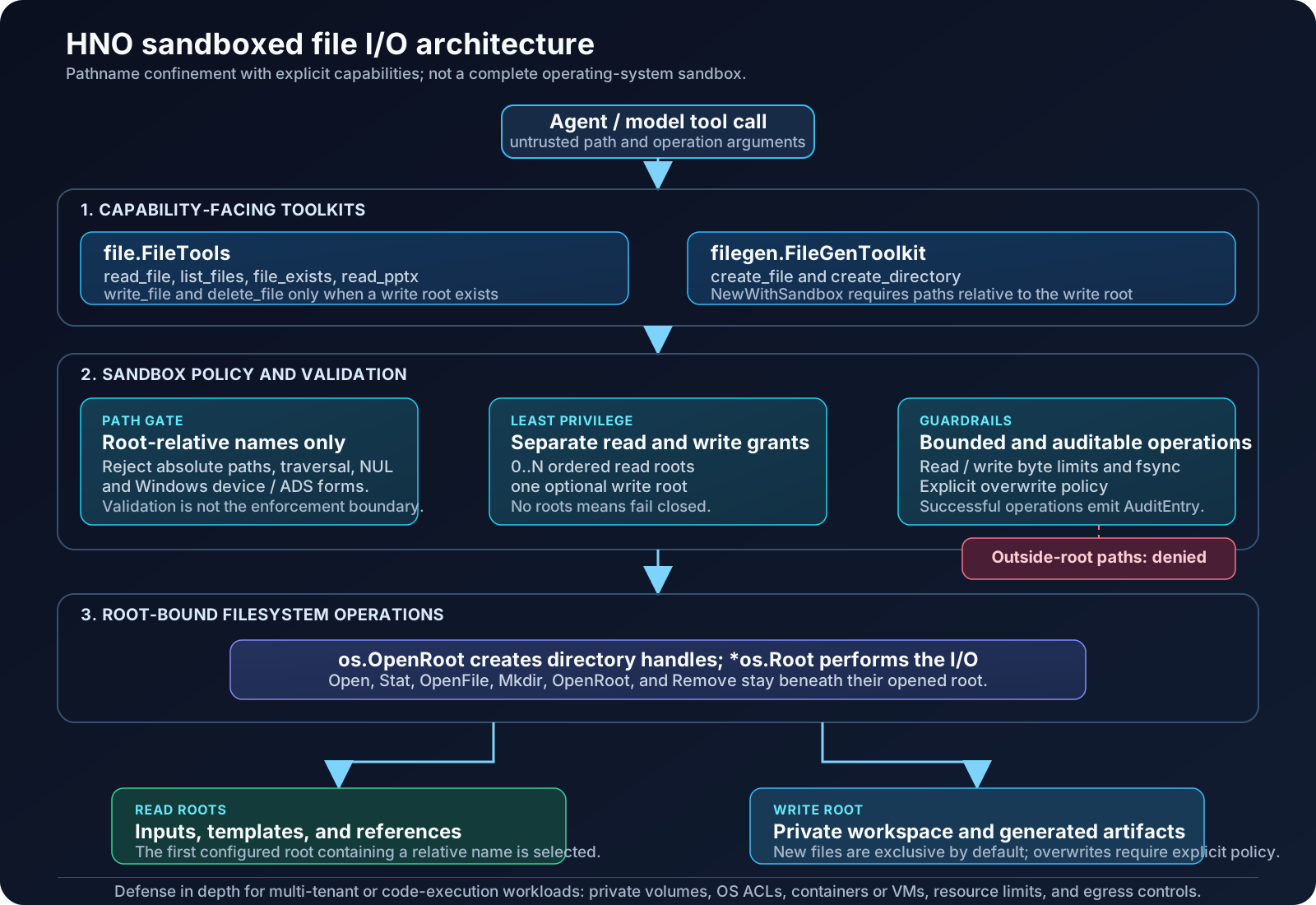
HNO's new sandboxed file-I/O design answers that with explicit read and write capabilities, root-relative agent paths, and Go's root-bound filesystem handles.
The trap in a path-prefix allowlist
A first implementation often looks like this:
- make an untrusted path absolute;
- compare it with an allowed directory;
- call
os.ReadFileoros.WriteFileon that path.
That catches many obvious ../ cases. It is still not enough for an Agent runtime. A symbolic link can change what the checked name resolves to, and the filesystem state can change between validation and the unrestricted I/O call. Windows also introduces drive-relative, UNC, device, and alternate-data-stream forms that a portable string check must account for.
The lesson is not that input validation is useless. It is that validation should provide early rejection and clear errors, while the actual filesystem primitive must enforce the boundary.
The architecture: capability first, handle-bound enforcement second
HNO creates a sandbox with explicit roots:
sandbox, err := file.NewSandbox(
    file.WithReadRoots("./inputs", "./templates"),
    file.WithWriteRoot("./workspace"),
    file.WithMaxReadBytes(10<<20),
    file.WithMaxWriteBytes(5<<20),
)
if err != nil {
    log.Fatal(err)
}
defer sandbox.Close()

readWriteTools := file.NewWithSandbox(sandbox)
generationTools := filegen.NewWithSandbox(sandbox)The flow has three layers:
- Toolkits expose familiar Agent tools.
file.FileToolshandles reading, listing, metadata, PPTX extraction, writing, and deletion.filegenhandles artifact creation. - The sandbox policy decides whether a requested operation has read or write capability, rejects unsafe root-relative names, applies byte limits, controls overwrites, and can emit audit entries.
os.Roothandles perform the realOpen,Stat,OpenFile,Mkdir,OpenRoot, andRemoveoperations. A resolved path cannot leave the directory tree represented by the handle, including by following a symbolic link outside that tree.
The path supplied by an Agent is not a host path. It is a name relative to a configured root, such as reports/summary.md.
Read and write are different grants
A read root does not silently create write access, and a write root does not silently create read access. That makes it practical to assemble smaller Agent capabilities:
- a reviewer can read
./inputsand./templatesbut cannot change them; - a generator can write only to
./workspace; - a run can use a private per-tenant workspace without exposing the host checkout or home directory;
- a sandbox with no roots denies all operations by default.
Multiple read roots are checked in configuration order. The first one containing the requested relative name is used. There is exactly one write root, which keeps generated artifacts in a single intentional destination.
Generation needs an additional overwrite decision
filegen.create_file has an overwrite tool argument because creating a new artifact and replacing an existing one are materially different actions.
The sandbox requires two independent approvals before replacement:
- the tool call says
overwrite: true; and - the host configured
file.WithAllowOverwrite(true).
This prevents a model from replacing a file simply because the application has the technical ability to do so. New files are created exclusively by default. For Go 1.24 compatibility, an authorized replacement uses a root-bound truncate-and-write operation rather than an atomic rename; critical publication flows should generate and validate a new artifact before a higher-level, controlled release step promotes it.
What the sandbox does not replace
This feature confines file-tool path resolution. It does not turn arbitrary code execution into a safe operation. It does not restrict outbound network access, CPU, memory, processes, mounts, or privileged resources that already exist inside a granted root.
For an untrusted or multi-tenant workload, use the file sandbox as one layer in a defense-in-depth design:
- a private volume or directory tree per run or tenant;
- least-privilege service accounts and filesystem ACLs;
- containers, VMs, or a dedicated execution sandbox for processes;
- memory, CPU, process, and disk quotas;
- egress controls and durable audit logging.
This boundary statement matters as much as the implementation. A path sandbox is strong at preventing pathname escape when given a careful root. It is not an excuse to mount a sensitive host filesystem into an untrusted execution environment.
A testable security contract
The regression suite covers the operational contract rather than only happy paths: fail-closed startup, separated capabilities, path traversal, absolute and Windows special paths, symbolic-link escape attempts, final-link targets, read/write size limits, parent creation, audit events, and the filegen overwrite rule.
Run the focused checks with:
go test ./pkg/hno/tools/file/... ./pkg/hno/tools/filegen/... -v
go vet ./pkg/hno/tools/file/... ./pkg/hno/tools/filegen/...For the complete API contract, deployment guidance, and the full architecture walkthrough, see the Sandboxed File I/O guide.